

Where Are You on "The Clean Comedy Spectrum?"
A Few Thoughts on Definitions and Clarity (Comedy Mindhacks #134)

A couple weeks ago, I participated in a 3-day clean comedy competition. During the days there were workshops put on by seasoned comedians and, during the evenings, those same folks doubled as competition judges. They also took turns doing spots during the nightly shows. On the final night of the competition, a number of competitors told some rather edgy and risqué jokes. So, when one of the judges got up to do his set, he started by saying something like, “Welcome to The Cleanest Dirty Comedy Competition” around. He went on to say, “I don’t know exactly what this is.”
I think I know at least part of the reason why. Let me explain. As a “clean” comedian, one of the most common questions I hear, especially from other comedians is, “What do you mean by ‘clean’”? Many bookers I’ve worked with are also prone to asking, “You work ‘clean,’ right?” My answer is always yes, but over time I’ve learned that’s rarely the end of the conversation and often the beginning of the confusion. I’m pretty convinced at the moment that the word “clean” in “clean comedy” is one of the most misunderstood words in all of stand-up comedy in general.
At first glance, one might assume that everyone means roughly the same thing when they’re talking about “clean comedy.” The reality is: Many of us are using the same words while describing very different expectations. Some venues are perfectly comfortable with jokes about dating, politics, or awkward marriages as long as there’s no profanity. Others don’t want innuendo of any kind because children will be in the audience or because that’s just not something they’re interested in. Still others prefer that certain topics never come up at all, regardless of how tastefully they’re handled. None of those venues are wrong, but they’re definitely not talking about the same definition of “clean.”
So, “clean comedy” has a problem, a communication problem. We clean comedians keep using one word to describe four or five different standards, then we wonder why comedians occasionally offend audiences or why venues sometimes feel disappointed after a performance. Now, let me be clear: Most of those situations aren’t the result of bad intentions; instead, they’re the result of two people assuming they agree when they actually haven’t defined the terms.
We all know, just as psychologists have known for years, that when use familiar words like “family-friendly,” “corporate,” or “clean,” our brains quietly fill in the details without realizing someone else may have filled them in differently. The upshot of that is that conversations can move quickly. Every once in a while, though, that kinda shortcut can create misunderstandings that could have been avoided.
Recently, I’ve been thinking that comedians and bookers need a way to get on the same page. That starts with vocabulary. Instead of endlessly debating what counts as “clean comedy,” what if we could just describe different grades of clean comedy? In other words, what if the conversation shifted from defending definitions of one word to identifying and clarifying expectations across a spectrum?
That’s exactly what led me to create The Clean Comedy Spectrum. It’s not intended to judge comedians or rank one style of comedy above another at all. Every point on this spectrum has its place because every audience is different. The framework simply gives comedians and venues a common language so everyone knows what kind of show is being discussed before anyone walks on stage. There may be more types that I’ve missed, but this is a start. If you have others, let me know and I can add them. Here’s what I’ve got thus far to start.
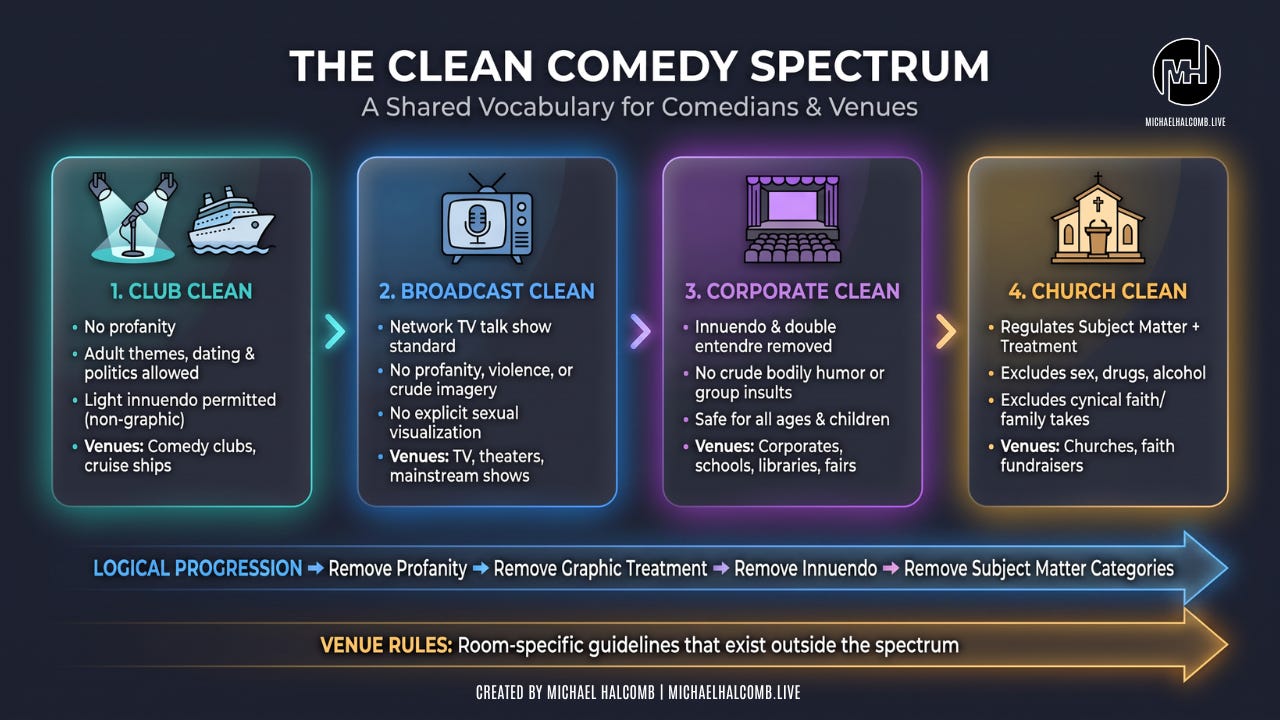
Club Clean: At the left-most and broadest end of the spectrum is Club Clean. This probably goes for many cruise ships, too. (Of course, many cruise ships have both a “Club Clean” show but also a dirty show.) With this there’s no profanity, but adult themes, dating, relationships, politics, substances, and occasional innuendo are still acceptable as long as nothing becomes graphic or explicit. Many comedy clubs advertising a clean night probably fit somewhere in this category. It’s still clean comedy, but it’s also the most flexible definition of the word.
Broadcast Clean: Next on this spectrum, we’re essentially talking about TV. Here profanity is absent and most adult themes, violence, and crude descriptions disappear as well. If there is an adult topic, the innuendo should not lead someone watching or listening to visualize sexual body parts, acts, or images. Essentially, it’s handled with the same general standards audiences have traditionally expected from network television, particularly the late night talk shows.
Corporate Clean: This includes everything required for Broadcast Clean while also removing innuendo altogether. Nothing depends on adults catching a second meaning that children won’t understand, and the humor doesn’t rely on crude bodily functions or insulting particular groups. This is where many schools, libraries, corporate events, fairs, and genuine family shows actually live, even if they simply advertise themselves as looking for a “clean comedian.”
Church Clean: This is the point where the spectrum changes in an important way because the restriction is no longer just about how a topic is handled. Here, certain subjects, such as sex, drugs, alcohol, or cynical takes on faith, marriage, and family, are often considered inappropriate regardless of how tastefully they’re presented. Put another way: The first three levels primarily regulate treatment, but Church Clean also regulates subject matter.
Again, there may be more points on this spectrum (if you have others, leave them in the comments). Even so, I think this visual is a helpful start because as we move from left to right, the restrictions build in a pretty logical sequence. First we remove profanity, then graphic treatment, then implication and innuendo, and finally entire categories of subject matter. Now, with this in mind, let me make an important point: Not every venue fits neatly into one category.
A church may be perfectly happy with marriage jokes but ask the comedian to avoid politics. A corporate client may allow references to alcohol while preferring that comedians stay away from religion. A theater might want Broadcast Clean comedy but ask every performer to avoid current events. That’s why I also think every booking should include a discussion of Venue Rules, because every room has its own unique expectations that exist outside the spectrum rather than on it.
With this, then, instead of asking a booker or venue, “How do you define ‘clean comedy?’” which is something they’ve probably never sat down and written, I can simply give them this chart and ask, “Where do you see your event falling on The Clean Comedy Spectrum?” That one question should result in clarity rather than confusion. Now, both sides can begin by talking about expectations instead of vague labels, which reduces the chances of misunderstanding.
My hope is that comedians, bookers, pastors, theaters, event planners, and so on can use this shared language to helps them communicate more clearly. So, I encourage you to download the image above, use it, and share it with others. If this helps even a handful of comedians avoid an awkward or confusing conversation, then it’ll have accomplished something worthwhile.
Now, having said all that, I’d love take a minute to encourage you to check out a new app I just created, an app I wish I’d have had years ago: Comedian Persona Explorer. Whether you begin with a single report or continue using it as you grow, my goal is simple: I hope you’ll spend less time chasing someone else’s identity and more time becoming the comedian only you can be. Check it out HERE.

Along the same lines, let me just say that, if reflections and tools like this are helpful to you, that’s also exactly why I wrote Comedy Mindhacks. My goal isn’t simply to help comedians write better jokes. It’s to help comedians understand the invisible thinking behind better comedy. Every mental model becomes another tool for building momentum, and over time those small shifts in thinking have a way of producing much bigger shifts on stage.

This entire book is built around helping comedians identify the mental obstacles, hurdle over them, and boost their momentum. If this article resonated with you, you’ll find a lot more like it inside the book. You can check out sample pages HERE. If you’re not yet a subscriber, use code MH10LIVE at checkout HERE for 10% off. Free subscribers automatically receive 15% off, and paid subscribers receive 35% off because I’m a big believer in rewarding people who invest in themselves. 👉 Click HERE to grab the book.
And if you’re ready to double down in a BIGGER way, consider joining my Comedy Vault. It’s my private collection of premium resources, trainings, workshops, and tools designed to help comedians continue growing long after the initial excitement fades. The first bet gets you into the game. Doubling down is what changes who you become.👉 Click HERE to unlock the Comedy Vault.
